

Firstflip™ Trainer Pro Twist
For learning full twists.
- Everything in the Pro bundle plus the twisting belt.
- A rotating waist belt on a machined aluminium ring with cable-spoke suspension.
- For learning full twists once your backflip is consistent.
Choose your setup
 Firstflip™ TrainerFor beginners
$199.99
 Firstflip™ Trainer YouthFor youth 14+Backorder - ships 2 weeks after order is placed.
$199.99
 Firstflip™ Trainer ProFor doubles and other sports
$269.00
 Firstflip™ Trainer Pro TwistBackorder - ships 2 weeks after order is placed.
$1,199.00Selected
Everything in the Pro bundle, plus the twisting belt: a machined aluminium ring on a cable-spoke suspension with a padded rotating waist belt, for learning full twists.
Specifications
- Waist range
- 65–130 cm
- Leg-loop range
- 48–74 cm
- Resting cord length
- 90 cm
VAT & duties included — no extra fees on delivery.
Worldwide shipping — calculated at checkout.
Yes. Heavy-duty braided bungee cords and a full-body harness. Each of the eight 12 mm shock cords was load-tested in our own lab to a 2,200 N (~224 kg) breaking load, and the end loops held to 1,400 N (~143 kg) before any slip. The bungees decelerate your rotation and soften landings. We always recommend mats or grass, checking your setup before every session, and having someone nearby when you train.
Any sturdy pull-up bar (wall-mounted or freestanding) or a strong tree branch. The mounting strap loops securely — no drilling or permanent installation.
Rider weight limit: 100 kg (220 lb). For reference, each of the eight 12 mm cords was load-tested in our own lab to a 2,200 N (~224 kg) breaking load, with the end loops holding to 1,400 N (~143 kg) before any slip.
Not at all. Designed for complete beginners. If you can jump, you can use it. The cords' resistance climbs steadily the further they stretch (see the lab data below), so you start with full support and gradually build toward unassisted flips.
It depends on how often you train and where you start. My progression runs through four levels of assistance — four bands down to one — and I ask for hundreds of repetitions at each level before you take a band off. Lukas went from never having flipped to landing one off a one-foot ledge in about a week on the prototype. The trainer doesn’t shorten the reps — it makes them safe to do.
You need enough ceiling height for rotation (9+ feet) and a sturdy mounted bar. Standard 8-foot ceilings are too low. A backyard, garage, or park pull-up station works great.
LOOK AT HOW OTHERS ARE LANDING IT
Reviews from real customers


See it in Action
HOW FIRSTFLIP™ TRAINER WORKS
Patent Pending

Who made this
I WAS SCARED OF IT TOO
Marcel spent thirty minutes working up the courage to try his first backflip in a lake. Twelve years later he built Firstflip™ — so you wouldn't have to start in one.
I know how you feel when you think about doing a backflip — trust me, I’ve been there. For years it seemed insanely impossible to ever overcome that fear. Just unbelievably scary.
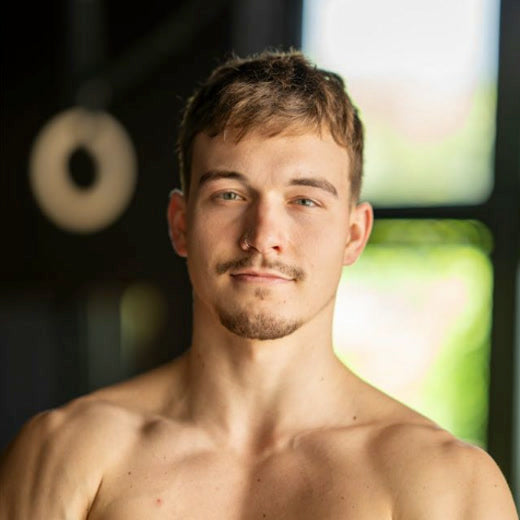 Marcel Dudek
Founder, Firstflip
Marcel learned his backflip as a teenager, standing knee-deep in a lake, because water was the only thing that made the worst outcome survivable. It took him thirty minutes to commit, then a step shallower, then sand, then grass. He built this trainer twelve years later, so nobody has to go find a lake first.
Read the full storyMarcel recorded a step-by-step video tutorial breaking down how to learn your first backflip.
Watch the free tutorialsTested to failure
WHAT THE CORDS ACTUALLY TAKE
Every cord on the trainer is the same cord. It was loaded on a tensile rig until it broke — here is what was recorded.
How far will the cords stretch for you?
Set your weight and how many bands you run.
Estimated resting stretch
A 90 cm cord stretches to 108 cm
Per cord, pulled to failure: the end loop began to slip at 1,400 N (about 143 kgf), the end loop pulled through at 1,680–1,824 N (about 171–186 kgf), and the cord body broke at 2,200–2,233 N (about 224–228 kgf).
The further it stretches, the harder it pulls back
Recorded pull-back force at three points of stretch, on one cord. This is why the bottom of a flip feels supported rather than sudden.
- 120% 9.5 kgf
- 200% 20 kgf
- 260% 27 kgf
Figures are pull-back force in kilograms-force, per cord — not the body weight a setup supports. Stretch percentages are as recorded in the test log.

Recorded test results and limitations
| What was measured | Recorded | Approx. |
|---|---|---|
| End loop begins to slip | 1,400 N | ~143 kgf |
| End loop pulls through | 1,680–1,824 N | ~171–186 kgf |
| Cord breaks | 2,200–2,233 N | ~224–228 kgf |
What this does and does not show
- These are laboratory test records on production samples.
- Always train on mats, check every strap, loop and carabiner before each session, and have someone nearby.
